Burn Before Reading by Turner Stansfield
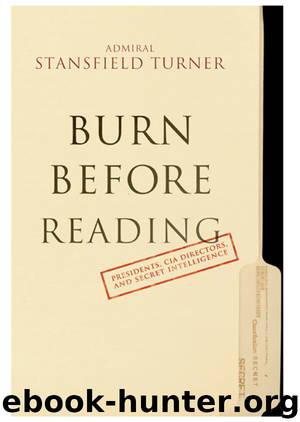
Author:Turner Stansfield
Language: eng
Format: epub
ISBN: 1401383491
Publisher: Hachette Books
CHAPTER EIGHT
JIMMY CARTER AND TURNER
The DCI Empowered*
In 1976, President Jimmy Carter was elected in some measure as a result of the public and congressional uproar and discontent over Watergate, the loss of public trust in the integrity of the White House, and the reports of domestic abuses by the CIA against U.S. citizens. President Carter had a mandate not only to clean house and raise public trust in national leadership but also to get the country’s intelligence apparatus under control. As a former naval officer who had served in the Navy’s nuclear power program under Admiral Hyman Rickover, he knew the importance of intelligence to national security. It needed to be fixed, not degraded, but first it had to be brought under control, the president’s control. However, he was not off to a good start. His first nominee for DCI was Theodore Sorenson, who had been John F. Kennedy’s speechwriter. Subsequently Sorenson had become a vocal critic of our involvement in Vietnam. As he prepared for his confirmation hearings for DCI before the Senate Select Committee on Intelligence, it became apparent that there would be questions as to whether some of those statements were unduly critical, perhaps unpatriotic. Faced with this unpleasant, and perhaps unwinnable, situation, Sorenson withdrew his name from consideration.
Two weeks after Sorenson’s withdrawal, on February 8, 1977, I went into the Oval Office for the first time. As I went through the door, President Carter was standing in front of a fireplace beneath a portrait of George Washington. I did not notice anyone else in the room, although it turned out the vice president, Walter Mondale, was there, and a photographer who caught my handshake with the president. The president suggested we go into his private office. We eased through a door on one side of the oval and across a narrow passage into a cozy office that looked out on the Rose Garden.* Jimmy Carter quickly dropped a bombshell on me: “Stan,” he started, “you are one of two candidates I am considering to be Director of Central Intelligence.”1 I saw my career in the United States Navy flash before my eyes. If he selected me for this position, one to which I had not aspired, I could say good-bye to everything I had worked for in the Navy. Jimmy Carter may have anticipated this. He immediately informed me that being DCI wasn’t just running the CIA, but much more. And so began my education about what my predecessor, George H. W. Bush, described to me a few weeks later as “the best job in Washington.”2
What struck me immediately was the amount of information about the role of the DCI the new president already had. It certainly could not have been acquired during his few short weeks in office. That Jimmy Carter had immersed himself so deeply in studying the role of the DCI showed me how important defining the authority of the DCI was to him. The DCI, he explained, was responsible for coordinating all of the agencies of the government involved in intelligence work—the Intelligence Community.
Download
This site does not store any files on its server. We only index and link to content provided by other sites. Please contact the content providers to delete copyright contents if any and email us, we'll remove relevant links or contents immediately.
| Anthropology | Archaeology |
| Philosophy | Politics & Government |
| Social Sciences | Sociology |
| Women's Studies |
The Secret History by Donna Tartt(19477)
The Social Justice Warrior Handbook by Lisa De Pasquale(12297)
Thirteen Reasons Why by Jay Asher(9130)
This Is How You Lose Her by Junot Diaz(7060)
Weapons of Math Destruction by Cathy O'Neil(6482)
Zero to One by Peter Thiel(5953)
Beartown by Fredrik Backman(5950)
The Myth of the Strong Leader by Archie Brown(5631)
The Fire Next Time by James Baldwin(5592)
How Democracies Die by Steven Levitsky & Daniel Ziblatt(5333)
Promise Me, Dad by Joe Biden(5237)
Stone's Rules by Roger Stone(5196)
A Higher Loyalty: Truth, Lies, and Leadership by James Comey(5092)
100 Deadly Skills by Clint Emerson(5032)
Rise and Kill First by Ronen Bergman(4907)
Secrecy World by Jake Bernstein(4892)
The David Icke Guide to the Global Conspiracy (and how to end it) by David Icke(4854)
The Doomsday Machine by Daniel Ellsberg(4627)
The Farm by Tom Rob Smith(4614)
